Cyanuric Acid: The Number That Quietly Runs Your Whole Pool
Cyanuric acid protects chlorine from sun - until it climbs so high the chlorine stops working. The Florida…
Read more →
Here’s how to lower pH in a pool, short version: add muriatic acid, dosed to your pool’s size and current reading, with the pump running — then retest in a few hours. The dose table below covers the typical cases. The longer version matters just as much in Florida, where pools drift high relentlessly and owners end up dosing acid every week without understanding why — so this guide covers the fix and the drift.
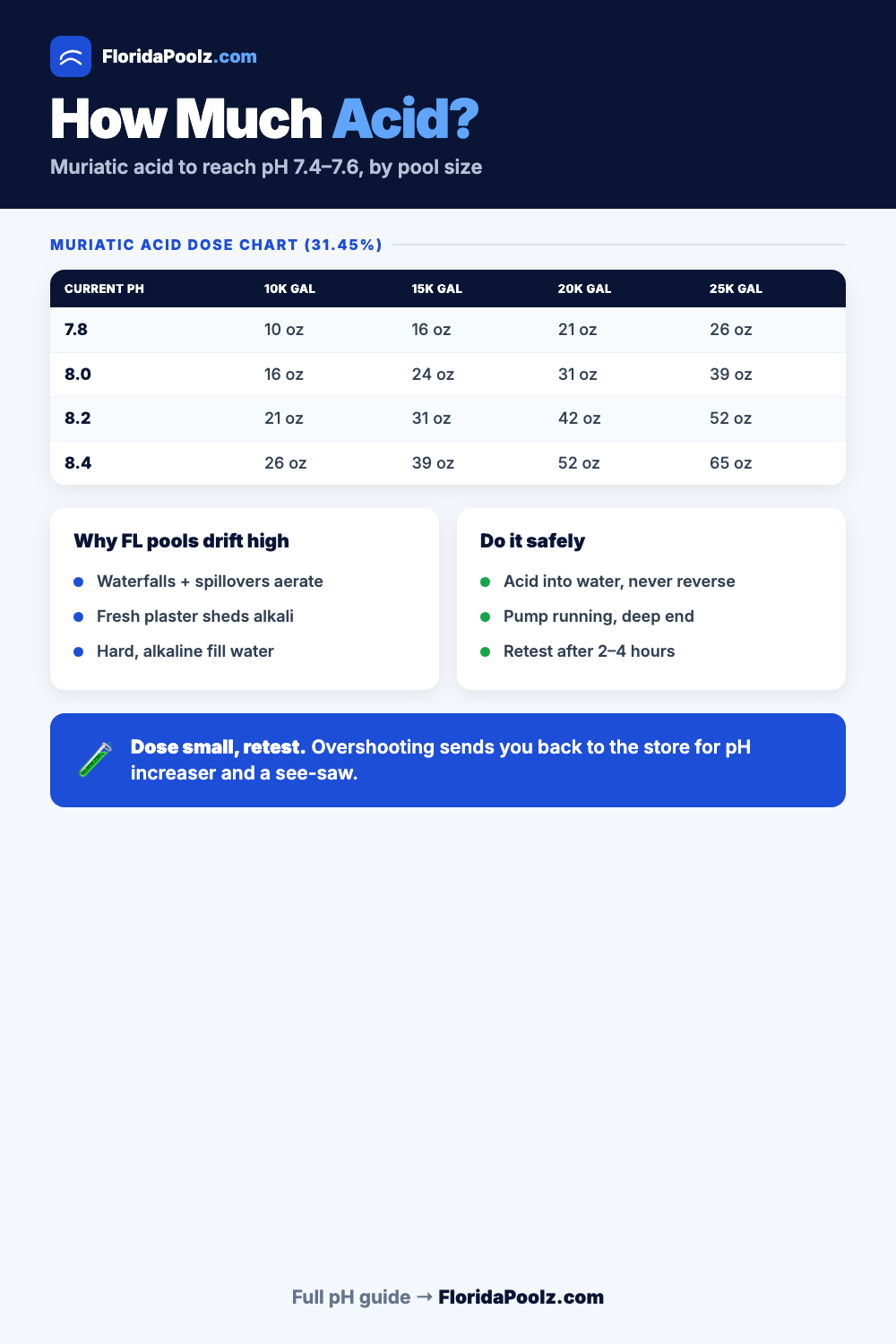
Amounts of standard-strength muriatic acid (31.45%) to bring pH down to the 7.4–7.6 target zone, with alkalinity in a normal range. Dilute per the label, pour with the pump running, retest after 2–4 hours of circulation:
| Current pH | 10,000 gal | 15,000 gal | 20,000 gal | 25,000 gal |
|---|---|---|---|---|
| 7.8 | ~10 oz | ~16 oz | ~21 oz | ~26 oz |
| 8.0 | ~16 oz | ~24 oz | ~31 oz | ~39 oz |
| 8.2 | ~21 oz | ~31 oz | ~42 oz | ~52 oz |
| 8.4 | ~26 oz | ~39 oz | ~52 oz | ~65 oz |
Treat these as starting doses, not gospel — your alkalinity, water temperature, and acid concentration all bend the numbers. The safe habit: dose for the table, retest, dose again if needed. Undershooting costs you a retest; overshooting sends you to the store for pH increaser and starts a see-saw.
pH isn’t a comfort statistic — it’s a multiplier on your chlorine. As pH climbs from 7.4 toward 8.2, chlorine shifts into its weak, slow-acting form; the strip still shows a nice number, the sanitizing power quietly drops away. High-pH pools are where cloudy water and algae blooms get their head start with “fine” chlorine readings. Sustained high pH brings physical bills too: calcium scale on the waterline and inside the salt cell, and cloudiness that no clarifier fixes.
Low pH is the rarer, nastier failure — acidic water etches plaster, corrodes metal, and dissolves heater cores (the road to the copper-green pool). The target zone exists for a reason: 7.4–7.6, tested at least twice a week in a Florida summer.
A pool that needs acid every single week isn’t misbehaving — it’s doing physics. Three pushes stack up here:
Drift management beats drift panic: accept the weekly dose, or reduce the aeration you don’t need (run the waterfall for company, not 24/7).
| Muriatic acid (liquid) | Dry acid (sodium bisulfate) | |
|---|---|---|
| Cost per dose | Cheapest option | Roughly double |
| Handling | Fumes; splash risk; store carefully | Granular, gentler to handle |
| Side effects | None at pool doses | Adds sulfates — a slow problem for plaster and salt cells with heavy long-term use |
| Who uses it | Nearly every service tech’s truck | Owners who hate fumes; spa owners |
For a Florida pool dosing acid regularly, muriatic wins on cost and avoids the sulfate accumulation. Dry acid is a fair convenience choice for occasional, small corrections.
Never mix acid with anything, never pour it through the skimmer, and never dose right before swimmers get in — give it a circulation cycle first.
Acid lowers pH and alkalinity together — which is either a feature or a problem depending on your numbers:
Vinegar and citric acid do lower pH — at a price and volume that make no sense at pool scale, and with a bonus: they’re organic material your chlorine then has to burn, so you trade a pH problem for a sanitizer bill. There’s no baking-soda-style gentle fix in this direction. The natural levers that do exist are subtractive: less aeration, less alkaline fill, letting CO2 build by cutting splash features. For the actual correction, acid is the tool. It’s fine. Every clear pool you’ve admired runs on it.
These three run your water as a system, and fixing one with the others ignored is the classic Florida frustration loop. pH sets how hard your chlorine works; stabilizer (cyanuric acid) sets how much chlorine you need in the first place — and years of trichlor pucks quietly raise stabilizer even as they add acid, masking pH drift as they lock up your chlorine. If your pool eats acid and struggles to hold sanitizer, read the cyanuric acid guide next; the two problems usually share a cause.
And when weekly dosing, retesting, and see-sawing numbers stop being a satisfying hobby — that’s what a weekly service route is for. Licensed Florida pool pros are in the directory, chemistry included.
After a full circulation cycle — 2 to 4 hours with the pump running — and a retest showing pH back in range. The acid disperses fast; the wait is for mixing, so nobody swims through an undiluted pocket.
No single chemical does that — acid always drops both. The workaround is sequencing: acid drops both, then aeration raises pH alone. Run the cycle until both land in range.
pH and alkalinity fall too far, and acidic water starts on your plaster, metals, and heater. Retest, then raise pH with aeration and, if alkalinity also crashed, baking soda. The prevention is boring: dose conservatively and retest.
Aeration (waterfalls, spillovers, spa jets), plaster under a year or two old, alkaline fill water, or all three. That’s most Florida pools. It’s a maintenance rhythm, not a malfunction — weekly testing plus a routine dose keeps it pinned.
Not useless — slow and weak. At pH 8.2 the active fraction of your chlorine is a sliver of its 7.4 strength, which is why high-pH pools bloom algae with “good” chlorine readings. Fix pH before judging any chlorine problem.

We build Florida's pool contractor directory from county permit records, DBPR license data, and verified Google reviews — and write these guides from the same data, with input from the licensed builders and service pros listed on the site.
Straight-talking, Florida-specific help — written from permit data and local pros.
Cyanuric acid protects chlorine from sun - until it climbs so high the chlorine stops working. The Florida…
Read more →
Mustard algae looks like dirt, brushes off in a yellow cloud, and resettles by morning. The kill protocol,…
Read more →
Black algae in a pool digs roots into plaster and shrugs off normal shock. Here's the removal protocol…
Read more →