How to Lower pH in a Pool (Without Wrecking Your Alkalinity)
How to lower pH in a pool with muriatic acid: dose amounts by pool size, safe handling steps,…
Read more →
Cloudy pool water has exactly three causes: chemistry that’s off, a filter that isn’t doing its job, or something the weather dumped in. That’s the whole list. Test your water, check your filter pressure, think about the last 48 hours — and you’ll know which one you’re fighting before you spend a dollar at the pool store.
Most cloudy Florida pools clear in a day or two once you treat the actual cause. The owners who stay stuck are the ones pouring clarifier into a pool with no chlorine in it, week after week, wondering why the milk look keeps coming back.
Cloudiness is millions of particles too small for your filter to grab — dead algae, pollen, fine dust, precipitated calcium, or organic junk your chlorine hasn’t finished burning through. Individually invisible. Together, they scatter light and turn the water dull, hazy, or full-on milky.
That matters for one practical reason: clearing the water means either killing what’s growing, filtering out what’s floating, or both. Every fix in this guide is one of those two jobs.
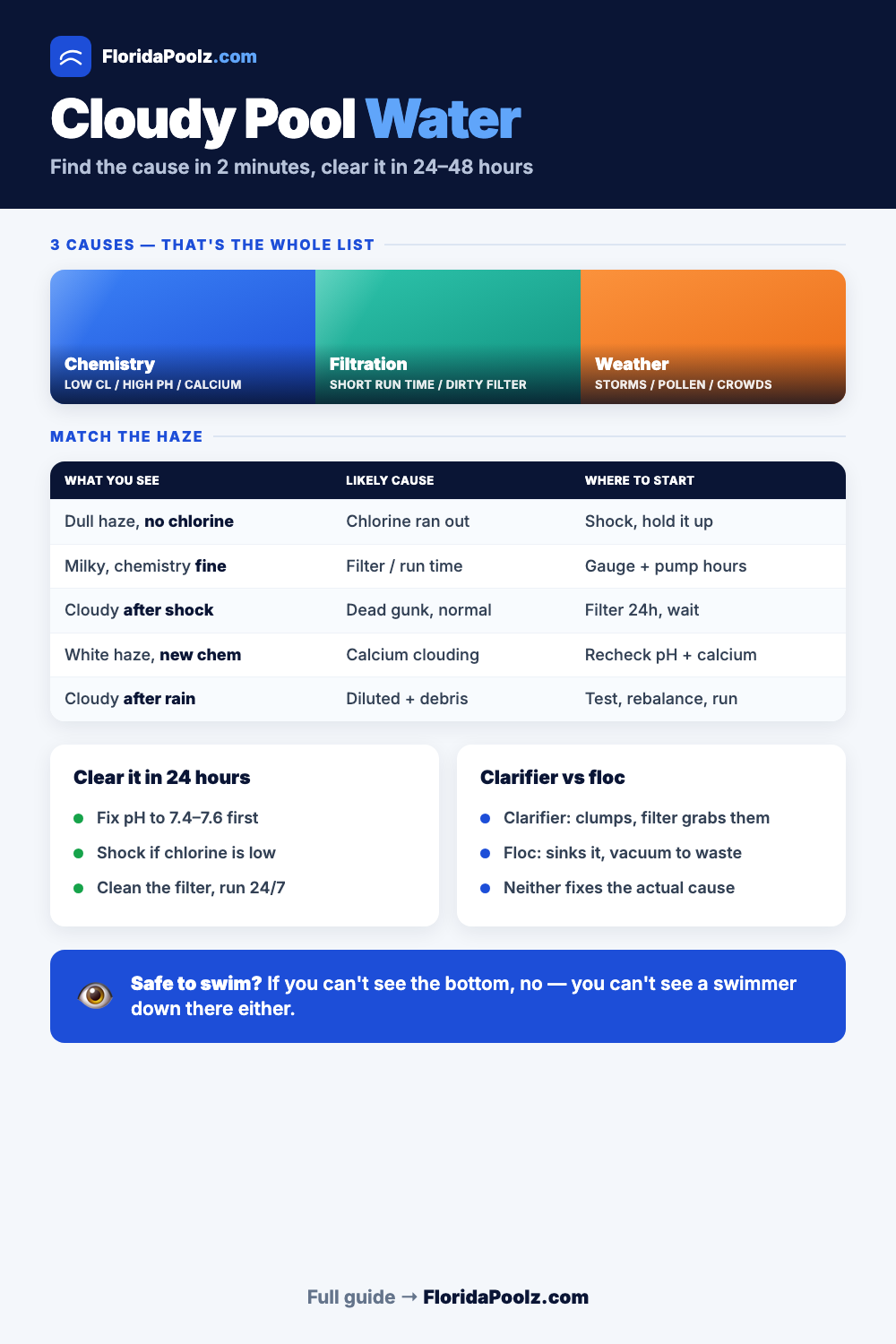
Grab your test kit before anything else. The pattern of the cloudiness plus one water test points at the cause almost every time:
| What you see | Most likely cause | Where to start |
|---|---|---|
| Dull haze, chlorine tests near zero | Chlorine ran out; early algae bloom | Shock, then hold chlorine up |
| Milky white, chemistry tests fine | Filter problem or crushed run time | Filter pressure and pump hours |
| Cloudy right after shocking | Oxidized junk waiting for the filter | Run the filter, wait 24 hours |
| Cloudy after a storm | Rain-washed debris and diluted chlorine | Test, rebalance, extend pump hours |
| White haze after adding calcium or raising pH | Calcium clouding out of solution | Recheck pH and calcium hardness |
| Green tint plus cloudiness | Algae, not debris | That’s a different fight — see below |
A cloudy pool with a green cast isn’t a cloudy-water problem at all. That’s algae getting started, and clarifier will do nothing for it. Head to our guide on getting rid of pool algae — or if you’re not sure what shade you’re looking at, work out why your pool is green first.
Chlorine doesn’t just sanitize — it oxidizes the invisible organic load your pool collects every day: sunscreen, sweat, leaf tannins, bird droppings, whatever blows in through the cage screens. When free chlorine drops near zero, that load builds up faster than it burns off. The water goes dull a day or two before algae ever shows.
Florida makes this worse in two specific ways. Water at 88°F eats chlorine far faster than the 78°F pools most national advice is written for. And summer UV is relentless — without enough stabilizer, sunlight strips your chlorine by mid-afternoon.
The fix: test free chlorine. If it’s under 1 ppm, shock the pool tonight (after sundown, so the sun doesn’t eat half the dose) and retest in the morning. Keep free chlorine in the 3–5 ppm range through a Florida summer.
Chlorine’s killing power falls off a cliff as pH climbs. At a pH of 8.0-plus, most of your chlorine is sitting in a weak, slow form — the test strip says you have plenty, the water says otherwise. Florida pools drift high naturally: fresh plaster, aeration from waterfalls and spillovers, and high-alkalinity fill water all push pH up.
The fix: bring pH back to 7.4–7.6 with muriatic acid before you judge how well your chlorine is working. Dose, run the pump an hour, retest.
Push calcium hardness and pH up at the same time and calcium carbonate falls out of solution as a fine white dust — instant milk. It happens right after adding calcium increaser, after big pH swings, and in pools filled from hard well water. The giveaway: the haze appeared within hours of adding a chemical, and everything else tests normal.
The fix: stop adding anything, get pH back to 7.4–7.6, and let the filter collect the dust over a day or two. Persistent calcium haze in high-calcium fill areas sometimes needs a sequestrant to hold minerals in solution.
Advice written for a Michigan summer says six hours of pump time is fine. In a Florida July, with water pushing 90°F and a daily thunderstorm feeding the pool nutrients, six hours won’t keep up. The water clouds slowly over a week or two, chemistry testing normal the whole time, and every pool forum thread from Tampa to Naples in June says the same thing: the pump wasn’t running long enough.
The fix: a Florida pool in summer wants its full volume turned over at least once a day — for most single-speed setups that’s 8–10 hours, and for a variable-speed pump it’s low speed most of the day. Cloudy water is the signal to add hours, not chemicals.
Check the pressure gauge on the filter tank. Running 8–10 psi over its clean baseline means the filter is choked and water is barely moving through it. The opposite failure is sneakier: a torn cartridge pleat, a cracked lateral in a sand filter, or blown DE grids let unfiltered water pass straight back to the pool — sometimes you’ll see a puff of dust from the returns.
The fix: clean the filter (hose down cartridges, backwash sand or DE), then watch the pressure. If it never comes back down to baseline, or cloudiness returns within days, the media is at the end of its life. Cartridges last a couple of seasons in year-round Florida service; sand goes years but not forever.
Cloud that hangs in one corner of the pool — usually behind steps, in a swim-out, or along the far wall away from the returns — is a circulation problem, not a water problem. Angle your return jets so the surface water visibly spirals, and brush those corners weekly to throw settled particles back into the moving water where the filter gets a shot at them.
Some clouding has nothing to do with anything you did:
The response to all of these is the same: test, rebalance, extend the pump run for a day or two, and let the filter catch up. After a storm, get ahead of it — check the water that evening, not three days later when it’s dull.
Shock a tired pool and the water often turns cloudier for a day. That’s the chlorine doing its job — oxidizing dissolved gunk into particles the filter can finally trap, and killing off early algae you couldn’t see yet. The dead material has to go somewhere, and until the filter collects it, it floats.
Give it 24 hours of continuous filtering. Clearing water with falling filter pressure is a pool mid-recovery. Two exceptions mean something else is going on: a white haze that showed up instantly as the shock hit the water points at calcium clouding, and a pool that shocks up cloudy-green then stays green means the algae won the first round — go kill it properly.
Cause identified or not, this sequence clears the big majority of cloudy Florida pools:
Both products exist for one situation: particles too fine for your filter. They work in opposite directions, and picking wrong makes a mess.
| Clarifier | Flocculant | |
|---|---|---|
| What it does | Clumps fine particles into filter-sized ones | Sinks everything to the floor in a blanket |
| What you do next | Keep the filter running; it collects the clumps | Vacuum the blanket to waste, by hand, slowly |
| Speed | 2–3 days, hands-off | Overnight, then a careful morning of work |
| Best for | Mild haze, pollen, post-shock cleanup | Heavy milk you can’t see through |
| Catch | Overdosing makes water cloudier | Needs a multiport valve with a waste setting; skips the filter entirely |
The honest note pool stores skip: neither one fixes a cause. Clarifier on a pool with no chlorine buys you three clear days before the haze returns. Fix chemistry and filtration first; use these to speed up the last mile. And if you have a cartridge filter, flocculant is mostly off the table — no waste line means all that settled junk goes straight into your cartridge.
No — and not mainly for the reason you’d guess. Cloudy water usually means weak sanitizer, and the CDC ties poorly disinfected pools to recreational water illnesses. The bigger danger is simpler: if you can’t see the bottom, you can’t see a swimmer on the bottom. Drowning response time is measured in seconds, and murky water takes those seconds away. Florida leads the country in child drownings — keep kids out until you can see the main drain clearly.
A light haze with strong, tested chlorine is a judgment call for adults. A pool you can’t see into is closed. That’s the line.
Pools in Sarasota don’t get to coast the way pools in Ohio do — there’s no off-season, and summer is an arms race between your chlorine and the climate. The clear-water routine that works here:
If the pool clouds up every few weeks no matter what you do, something structural is off — an undersized filter, a failing pump, plumbing that short-circuits circulation. That’s a diagnosis visit, not a chemical run. A licensed Florida pool service can pressure-test the system and find what a test strip never will — find one near you in the Pools Premium directory.
When the cause is organic — low chlorine, early algae, post-party gunk — yes, shock plus 24 hours of filtering clears it. When the cause is calcium clouding or a broken filter, shock changes nothing. Test first, shock second.
With the cause fixed and the pump running around the clock: mild haze clears in about a day, heavy milk in two to three. Flocculant plus a vacuum-to-waste session compresses that to overnight. A pool still fully cloudy after 48 hours of correct treatment has a second problem — usually the filter.
Not directly — the haze after a big shock is oxidized debris, not the chlorine itself. The related real problem: shocking with cal-hypo raises calcium every time, and in an already-hard Florida pool that pushes you toward calcium clouding. Liquid chlorine sidesteps it.
Rain dilutes chlorine, drops airborne dust and pollen, and washes deck runoff into the water — three cloud sources in one afternoon. Florida summer pattern: test and rebalance the same evening after any real storm, and give the pump a long night.
No. Baking soda raises alkalinity (and pH a little) — useful when alkalinity is low, but it clears nothing, and over-adding it pushes pH high enough to cause haze. It’s a balancing chemical, not a clearing one.
Heat speeds up everything: chlorine burns off faster, organics grow faster, and swimmers show up more often. An 88°F pool on a 95°F week simply needs more chlorine and more filter hours than the same pool in February. The cloudiness is the gap between what the pool needs and what it’s getting.

We build Florida's pool contractor directory from county permit records, DBPR license data, and verified Google reviews — and write these guides from the same data, with input from the licensed builders and service pros listed on the site.
Straight-talking, Florida-specific help — written from permit data and local pros.
How to lower pH in a pool with muriatic acid: dose amounts by pool size, safe handling steps,…
Read more →
Cyanuric acid protects chlorine from sun - until it climbs so high the chlorine stops working. The Florida…
Read more →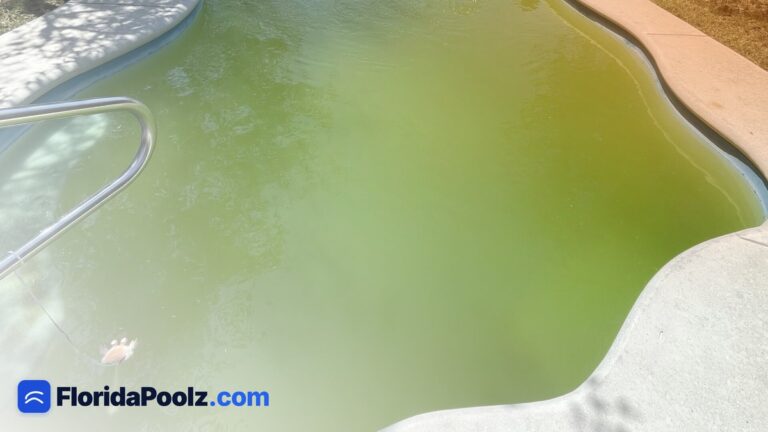
Mustard algae looks like dirt, brushes off in a yellow cloud, and resettles by morning. The kill protocol,…
Read more →