
Pool Leak Detection: Find It Yourself Before You Pay Anyone
Pool leak detection starts free: the bucket test settles leak vs evaporation, dye finds the spot. Where Florida…
Read more →How long to run a pool pump in Florida: 8–10 hours a day in summer for a single-speed pump, 5–6 in winter — and if you own a variable-speed pump, run it most of the day at low RPM. That’s the answer for the typical pool; the manual that said “6 hours” was written for a Michigan July, not ours. Below: the turnover math so you can compute your own number, the schedules that survive contact with an electric bill, and the signs your current hours aren’t enough.
Your pump’s job is pushing every gallon through the filter and past the chlorinated flow at least once every 24 hours. The math is two numbers:
Divide: 15,000 gallons at 50 GPM is 300 minutes — 5 hours per turnover on paper. Florida then adds its tax: 85–90°F water pushes biology at double speed, daily storms deliver debris and nutrients, and the season never ends. The working rule here is one turnover minimum, aiming closer to 1.5–2 in high summer — which lands the typical single-speed pool at 8–10 hours June through September.
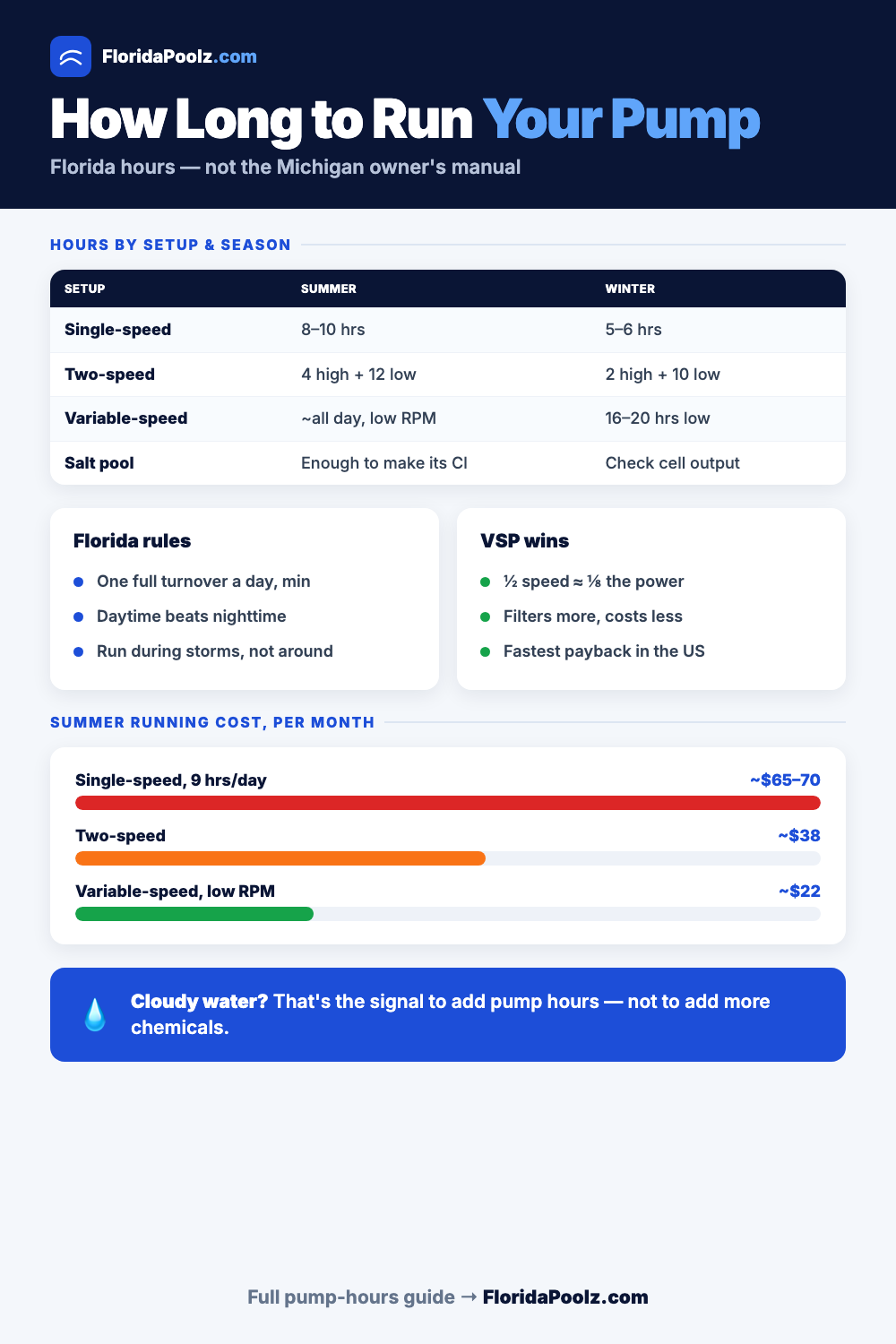
| Setup | Summer (May–Oct) | Winter (Nov–Apr) | Notes |
|---|---|---|---|
| Single-speed | 8–10 hrs | 5–6 hrs | Split shifts work: 6 hrs day + 3 hrs overnight |
| Two-speed | 4 hrs high + 12 low | 2 high + 10 low | High speed for skimming/vacuuming windows |
| Variable-speed | 20–24 hrs at low RPM + 2–4 hrs mid | 16–20 hrs low | The intended use: slow, long, cheap |
| Salt pool (any pump) | Whatever hours the cell needs to generate your daily chlorine — usually the binding constraint | Check the cell’s % output math | |
Three scheduling notes worth their pixels:
A single-speed pump is a light switch: full blast or nothing, and every hour costs the same real money — so owners ration hours, and rationed hours are how pools turn cloudy. A variable-speed pump rewrites the physics: pump power falls with the cube of speed, so half speed costs roughly an eighth the electricity. Running a VSP nearly all day at low RPM filters more total water than a single-speed’s 8-hour sprint, for less money, and keeps water perpetually moving — no dead hours for algae to settle and organize.
That’s why the honest answer to “how long should a VSP run” is “almost always, slowly.” It’s also why Florida’s year-round season makes VSP payback here about the fastest in the country — and why federal efficiency rules have pushed most pump replacements to variable-speed anyway. If you’re still rationing a single-speed’s hours, the next motor failure is your upgrade moment.
The flip side exists too: a winter pool running summer hours is just burning money. Seasonal adjustment twice a year is the whole discipline.
A common 1.5 HP single-speed pump draws in the neighborhood of 1.8 kW. At Florida’s residential rates — call it around 14¢ per kWh — that’s roughly 25¢ an hour: about $2.25 a day at 9 summer hours, $65–70 a month. The same pool on a variable-speed pump running 22 hours at low RPM plus a 2-hour high window typically lands at a third to a half of that, moving more water. Run your own numbers off your pump’s label wattage and your bill’s rate — the arithmetic takes two minutes and usually ends in a VSP purchase decision.
One expense no schedule fixes: a pump that’s loud, losing prime, or tripping breakers is asking for a repair visit, not more hours — Florida equipment techs are in the directory.
For a variable-speed pump at low RPM, it’s more than OK — it’s the intended design, and cheap. For a single-speed, 24/7 is overkill outside special situations (an algae fight, post-storm cleanup, a heavy party weekend) — the marginal filtering isn’t worth the full-power bill.
Short of a time-of-use plan forcing it, night-only is the worst standard schedule: chlorine goes unsupported through the day’s UV assault, algae photosynthesizes in still water, and the day’s debris sinks unskimmed. If off-peak pricing matters, split the difference — long night hours plus a midday window.
24 hours minimum, continuously — the chlorine needs distribution and the filter needs to collect what the shock kills. During a full algae siege, the pump simply doesn’t turn off until the water clears.
Fewer leaves, yes — but the cage does nothing about heat, spores, pollen fine enough to pass the mesh, or storm-blown nutrients. Treat a caged pool as maybe an hour lighter than the table, not half.
No — that’s a flow problem: choked filter, clogged impeller, suction air leak, or a dying motor. More hours on a compromised pump is more electricity for the same weak filtering. Fix the flow first; the pressure gauge and pump basket tell most of the story.

We build Florida's pool contractor directory from county permit records, DBPR license data, and verified Google reviews — and write these guides from the same data, with input from the licensed builders and service pros listed on the site.
Straight-talking, Florida-specific help — written from permit data and local pros.
Pool leak detection starts free: the bucket test settles leak vs evaporation, dye finds the spot. Where Florida…
Read more →
DIY pool heater reality check: solar covers and rings deliver real degrees for cheap, coil rigs mostly don't,…
Read more →
How to lower pH in a pool with muriatic acid: dose amounts by pool size, safe handling steps,…
Read more →