How to Lower pH in a Pool (Without Wrecking Your Alkalinity)
How to lower pH in a pool with muriatic acid: dose amounts by pool size, safe handling steps,…
Read more →
Cyanuric acid (CYA, stabilizer, conditioner — same chemical) is sunscreen for your chlorine: without it, Florida’s UV strips a pool’s free chlorine in a couple of hours; with it, chlorine survives the day. That’s the good half. The bad half is that CYA only ever goes up — and past a threshold it stops protecting your chlorine and starts smothering it, producing the most misdiagnosed problem in Florida pool care: a pool that reads “fine” on chlorine and still grows algae.
The pool store answer is another bottle. The real answer is usually a garden hose. Here’s the whole picture.
CYA molecules bind loosely to chlorine in the water, shielding it from UV. Bound chlorine survives sunlight but kills microbes far more slowly — the binding is the protection and the handicap. At sane CYA levels the trade is excellent: you lose some killing speed, you keep your chlorine all day. As CYA climbs, more of your chlorine sits bound and sluggish at any moment, and the “free chlorine” number on your test quietly stops meaning what you think it means.
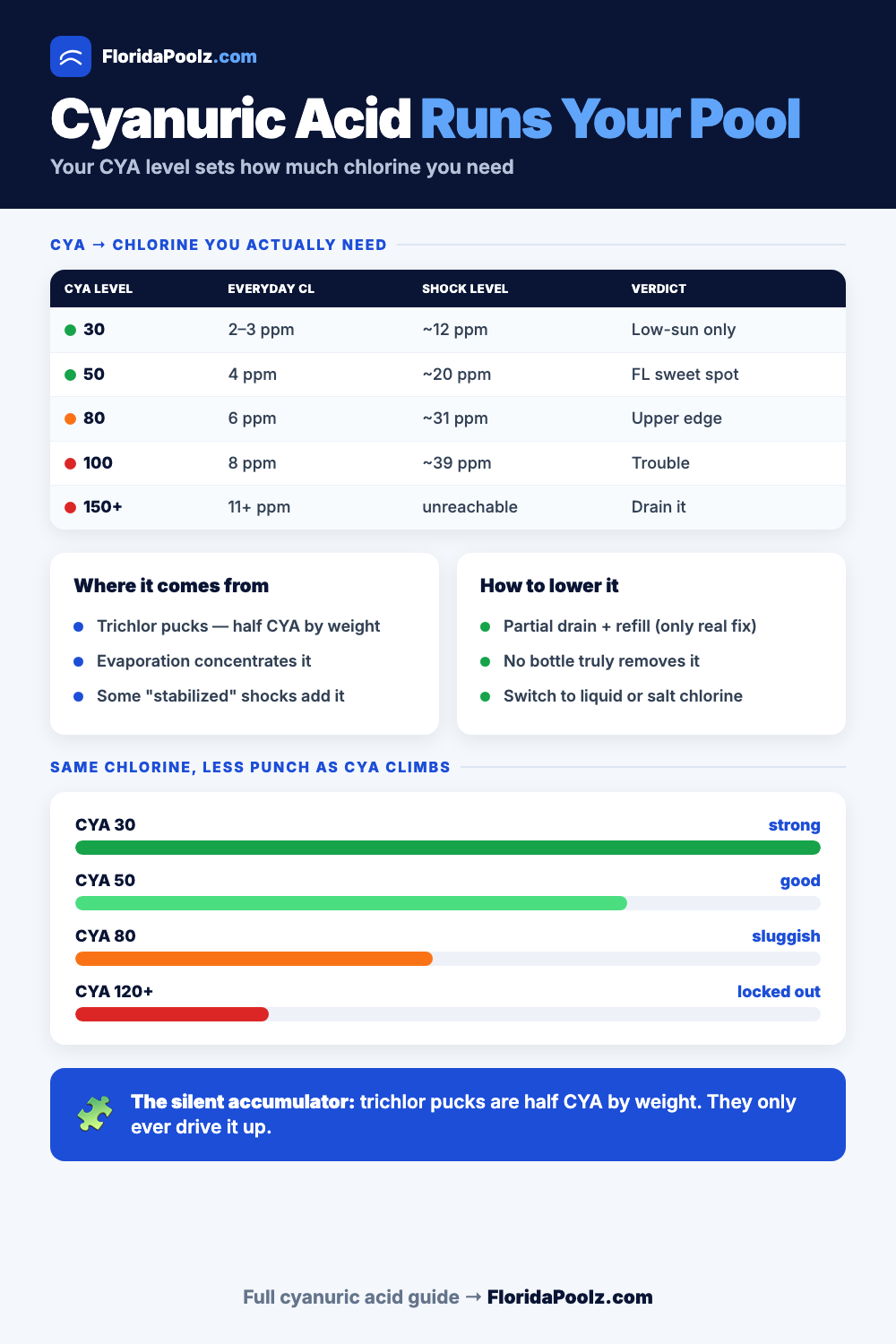
That’s the mechanism behind the rule that surprises everyone: how much chlorine your pool needs is set by your CYA level, not by a universal number. The community-standard ratio: everyday free chlorine at roughly 7.5% of CYA, and algae-killing shock level at roughly 40% of CYA. Concretely:
| CYA level | Everyday chlorine target | Shock (kill) level | Verdict |
|---|---|---|---|
| 30 ppm | 2–3 ppm | ~12 ppm | Fine for low-sun or indoor |
| 50 ppm | 4 ppm | ~20 ppm | The Florida sweet spot |
| 80 ppm | 6 ppm | ~31 ppm | Upper edge — manageable, pricier |
| 100 ppm | 8 ppm | ~39 ppm | Trouble — most owners never hold 8 |
| 150+ ppm | 11+ ppm | unreachable in practice | Chlorine lockout — drain territory |
A pool at CYA 150 holding 3 ppm of chlorine is, functionally, a pool with almost no working sanitizer — which is why it’s growing algae as every strip says everything’s fine.
Nobody pours stabilizer into their pool weekly. It arrives hidden: trichlor tablets — the standard white pucks in every floater and feeder — are more than half CYA by weight. Every puck dissolves into chlorine (which burns off and leaves) and stabilizer (which stays, forever). A puck-fed Florida pool adds several ppm of CYA every week, all season, every season. Two summers of pucks takes a pool from a healthy 40 to a locked-up 120 without the owner adding “stabilizer” once.
Evaporation makes it worse: Florida pools lose an inch or more of water a week in summer, and evaporation leaves CYA behind — the water leaves, the stabilizer concentrates. Rain and splash-out are the only natural exits, and they’re slow.
Two things about the standard turbidity test (the black-dot tube): it’s coarse, and most versions top out at 100 — a pool at 200 reads “100” and hides half its problem. If your reading pins at the top, run the dilution trick: mix equal parts pool water and tap water, test the mix, double the result. That’s how you learn your “100” is actually 180 — a completely different battle plan. Test CYA monthly on a puck-fed pool, quarterly otherwise, and always before any algae fight (the shock math depends on it).
CYA doesn’t evaporate, burn off, or filter out. Dilution is the cure — replace a fraction of the water, drop CYA by that fraction. From 120 toward a target of 50, you’re replacing roughly 60% of the pool, best done as two or three smaller drain-and-refill rounds. The math is honest and linear; the water bill is real; there is no bottle that beats a hose.
The Florida warning that belongs in bold: a drained pool can float. High groundwater — the default across much of the state, and a guarantee in rainy season — can lift an empty or near-empty shell out of the ground like a boat. “Pool popped” is a five-figure repair with no undo. The safe pattern: drain no more than a third to a half at a time, refill same-day, never drain right after heavy rain, and if your lot sits low or wet, hand the job to a pro who owns a well-point setup — licensed Florida pool companies are in the directory.
CYA-reducer packets (bio-remediation — enzymes or bacteria that eat stabilizer) exist and sometimes work: results in the community run from “dropped 30 ppm over three weeks” to “nothing happened, twice.” They’re slow, spendy per ppm, and unreliable enough that the water-change math usually wins. Fair to try if draining is genuinely impossible; go in expecting a coin flip.
Lowering CYA with trichlor pucks still feeding it is bailing a boat with the drain open. The two exits Florida pools actually use:
Pucks keep a legitimate role: vacation weeks and as a top-up during peak sun — used deliberately, not as the default diet.
A Florida pool with CYA under ~30 bleeds chlorine to the sun — dosed at dawn, unprotected by mid-afternoon, and the owner blames the chlorine brand. Fresh fills, heavy rain seasons, and salt pools that never get conditioner are the usual suspects. The fix is one deliberate addition of stabilizer to the 40–50 range — added slowly, tested, never “a bit extra for the summer,” and never via a winter of pucks. Salt-pool manufacturers typically want CYA at the higher end of normal; check the panel manual before dosing.
40–60 ppm for a standard chlorine pool — enough sun protection for a Florida summer without handcuffing the chlorine. Salt pools run higher per manufacturer spec, commonly 60–80. The number matters less than pairing it with the matching chlorine target.
No. Nothing you add lowers CYA — not shock, not clarifier, not time. Only water replacement (or the unreliable bio-reducers) brings it down. Shock with cal-hypo or liquid at least avoids adding more; trichlor-based shock adds CYA with every bag.
A typical floater eating two to three 3-inch pucks a week adds roughly 4–6 ppm of CYA weekly to a mid-size pool. Over a 30-week Florida season, that’s 120+ ppm of accumulation against almost no natural loss — one season from ideal to locked.
The drain-refill cycles themselves are the only downtime, and only for the hours involved. There’s no chemical phase — it’s a water exchange. Keep chlorine dosed to the ratio for whatever CYA level you’re currently at, and swim normally between rounds.
If CYA is under ~30, the sun is eating it — add stabilizer to 40–50. If CYA is high and chlorine reads present but the pool acts unsanitized (algae, smell, cloudiness), it’s the opposite problem: bound, sluggish chlorine. The same test answers both mysteries, which is why it’s always the first test.

We build Florida's pool contractor directory from county permit records, DBPR license data, and verified Google reviews — and write these guides from the same data, with input from the licensed builders and service pros listed on the site.
Straight-talking, Florida-specific help — written from permit data and local pros.
How to lower pH in a pool with muriatic acid: dose amounts by pool size, safe handling steps,…
Read more →
Mustard algae looks like dirt, brushes off in a yellow cloud, and resettles by morning. The kill protocol,…
Read more →
Black algae in a pool digs roots into plaster and shrugs off normal shock. Here's the removal protocol…
Read more →