How to Lower pH in a Pool (Without Wrecking Your Alkalinity)
How to lower pH in a pool with muriatic acid: dose amounts by pool size, safe handling steps,…
Read more →Mustard algae announces itself as a yellow-brown dust on shaded pool walls that brushes off in a puff, drifts, and resettles somewhere new by morning. Most owners spend two weeks vacuuming “dirt” or “pollen” before realizing the dirt is alive. It’s the middle child of pool algae — more chlorine-resistant than green, far easier than black — with one nasty specialty: it reinfects from your swimsuits, toys, and cleaning gear, which is why it keeps beating people who did everything else right.
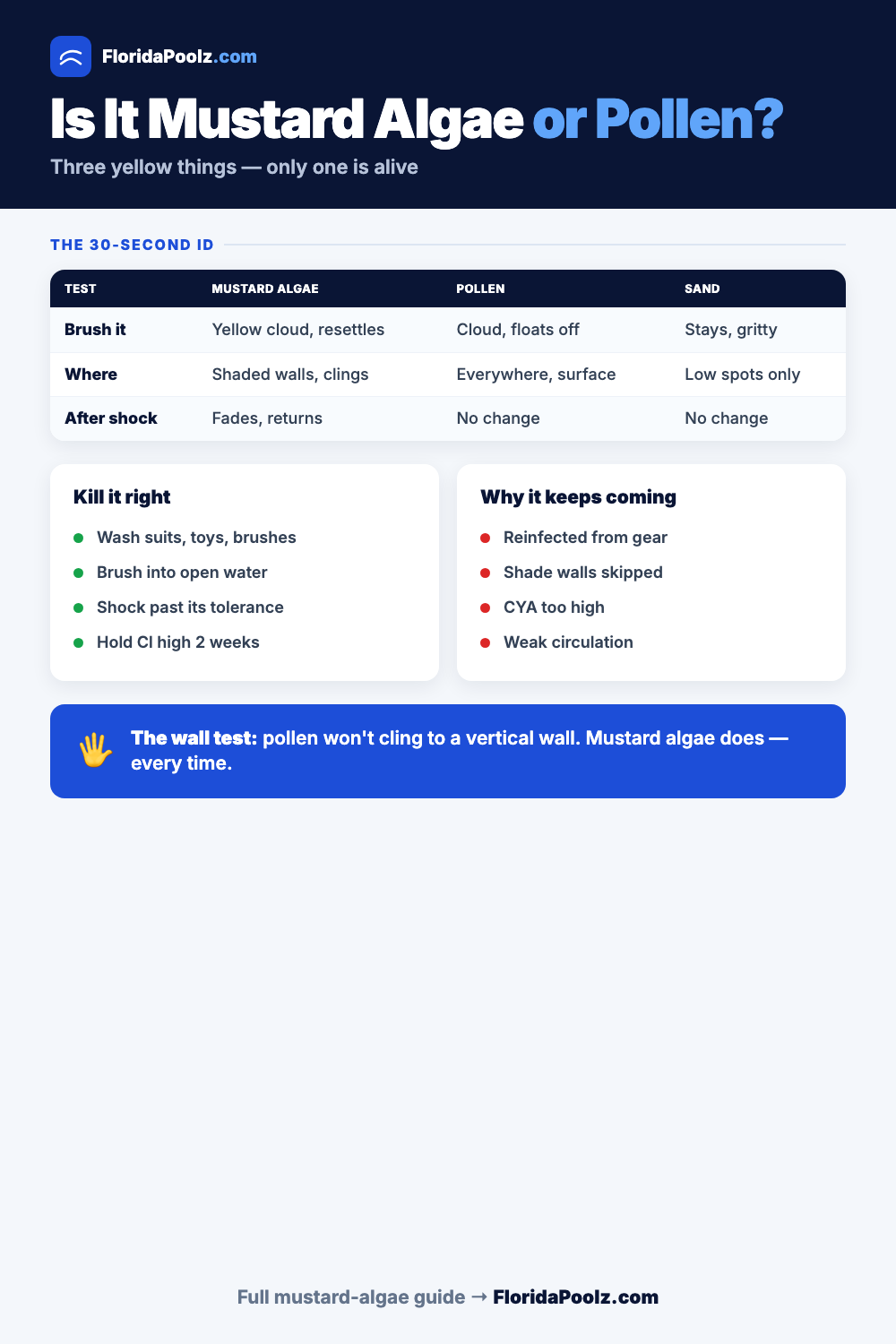
Three yellow things land on Florida pool floors, and only one of them is alive. Thirty seconds of poking tells you which you have:
| Test | Mustard algae | Pollen | Sand / dirt |
|---|---|---|---|
| Brush it | Lifts in a yellow smoke-cloud, resettles | Similar cloud — the great impostor | Mostly stays put, feels gritty |
| Where it sits | Shaded walls and floor spots; clings to sides | Everywhere evenly, floats on the surface first, collects in skimmer | Low spots and near steps only |
| Season | Any time, loves summer | Late winter–spring (pine and oak season) | After storms, lawn work, or a dig nearby |
| After shocking | Fades a shade, comes back within days | Unchanged — it was never alive | Unchanged |
The wall test is the strongest signal: pollen doesn’t cling to vertical surfaces; mustard algae does. Yellow film on a shaded wall two feet below the waterline is algae until proven otherwise. And if what you’re seeing is green and slimy rather than yellow and dusty, that’s a different fight — the green algae master guide covers it.
Mustard algae carries higher natural chlorine tolerance than green algae and prefers exactly the spots your sanitizer serves last: shaded, low-circulation wall sections — which in Florida means the permanent shade bands under the cage screen, behind ladders, and along the north-facing wall. Water flow is weakest there, chlorine arrives depleted, and UV never helps. A pool testing a healthy 3 ppm at the skimmer sits effectively unprotected in a dead corner.
It also shrugs off a routine shock: a single overnight spike knocks it back a shade, the survivors recolonize from the spores in your skimmer basket, brush bristles, and last weekend’s swim trunks. That’s the loop to break.
Before touching the water: hot-wash every swimsuit that’s been in the pool, run pool toys, floats, goggles, and cleaning attachments through a dilute bleach soak, and drop your brush heads and vacuum gear in the pool during treatment so the high chlorine sterilizes them too. Skip this step and the reinfection arrives with the first cannonball after you declare victory. This single habit is why some pools beat mustard algae once and others host it all summer.
Brush every yellow patch hard, plus the full wall circuit — the goal is getting the cells off the surface and into circulation where chlorine reaches them. Get behind ladders, into corners, along the shade band. Nylon bristles are fine for any surface; use steel only on plaster.
Mustard algae needs a stronger, longer chlorine siege than green — the community rule of thumb runs the kill level a notch higher than a standard SLAM (the sustained-shock method covered step-by-step in the master guide) and holds it for several days past visual victory. Liquid chlorine after sundown, re-dose as it burns down, keep the filter running around the clock. High stabilizer sabotages this entire step — if your pool has years of trichlor pucks behind it, read the cyanuric acid guide before buying chlorine.
Dead mustard algae settles as a duller, gray-yellow dust. Vacuum slowly — to waste if your valve allows — and give the known shade-zone patches a second brush-and-spike round no matter how clean they look. The post-kill cloudy phase clears the same way any dead bloom does: filtration, patience, and a clean cartridge.
Same finish line as any algae fight: clear water, walls that stay yellow-free for a week, and chlorine that holds overnight (a dusk-to-dawn loss of 1 ppm or less). Mustard algae’s comeback window is longer than green’s — keep chlorine at the high end of normal (4–5 ppm) for two weeks after victory.
The yellow-treatment packets at the pool store are mostly sodium bromide. They work by converting your chlorine into bromine, which mustard algae tolerates poorly — a real effect, and it looks miraculous for 48 hours. Two honest caveats. First, bromine burns off faster than chlorine in Florida sun and can’t be stabilized, so the pool runs unprotected sooner than the packaging implies. Second, the sodium bromide lingers and quietly converts your chlorine for weeks, raising your chemical spend. It’s a legitimate accelerant on a stubborn case; it isn’t a substitute for the brush-shock-decontaminate sequence, and most infestations fall to chlorine alone.
During treatment, no — kill-level chlorine closes the pool anyway. Before treatment, technically yes but unwisely: visible algae means sanitation is already losing, and swimmers redistribute the spores through the water and carry them out on their suits. Fix it first; it’s a weekend.
Almost always reinfection or a chlorine gap. The classic loop: kill the pool-side colony, skip the swimsuit wash, reintroduce spores the next pool party. Second place: the shade-band wall sections got brushed during treatment and never again. Third: stabilizer so high the everyday chlorine can’t hold the line.
Left alone for months it can leave yellowish shadows on plaster, but caught in the dust stage it wipes clean. Persistent yellow staining after a confirmed kill is more often metals or organic staining — a different diagnosis worth a professional eye.
It’ll collect the loose dust and turn into a reinfection vector — the filter bag and brushes hold live cells. Run the robot during the high-chlorine phase so it gets sterilized as it works, and rinse its filter with bleach solution afterward.
Wait one windless day. Pollen keeps arriving evenly and floats on the surface first; mustard algae grows where it already was and climbs walls. Or shock once: pollen ignores chlorine entirely, mustard fades then returns. Either behavior settles the question within 48 hours.

We build Florida's pool contractor directory from county permit records, DBPR license data, and verified Google reviews — and write these guides from the same data, with input from the licensed builders and service pros listed on the site.
Straight-talking, Florida-specific help — written from permit data and local pros.
How to lower pH in a pool with muriatic acid: dose amounts by pool size, safe handling steps,…
Read more →
Cyanuric acid protects chlorine from sun - until it climbs so high the chlorine stops working. The Florida…
Read more →
Black algae in a pool digs roots into plaster and shrugs off normal shock. Here's the removal protocol…
Read more →