How to Lower pH in a Pool (Without Wrecking Your Alkalinity)
How to lower pH in a pool with muriatic acid: dose amounts by pool size, safe handling steps,…
Read more →
Why is my pool green — one question, two very different answers. Green and cloudy means algae. Green but clear means metal, almost always copper. Get this one call right and the fix takes a weekend; get it wrong and you’ll shock a copper pool five times, watch it turn greener, and start pricing a drain.
Five minutes of looking, one water test, and you’ll know which pool you own.
Stand at the edge and look for the bottom.
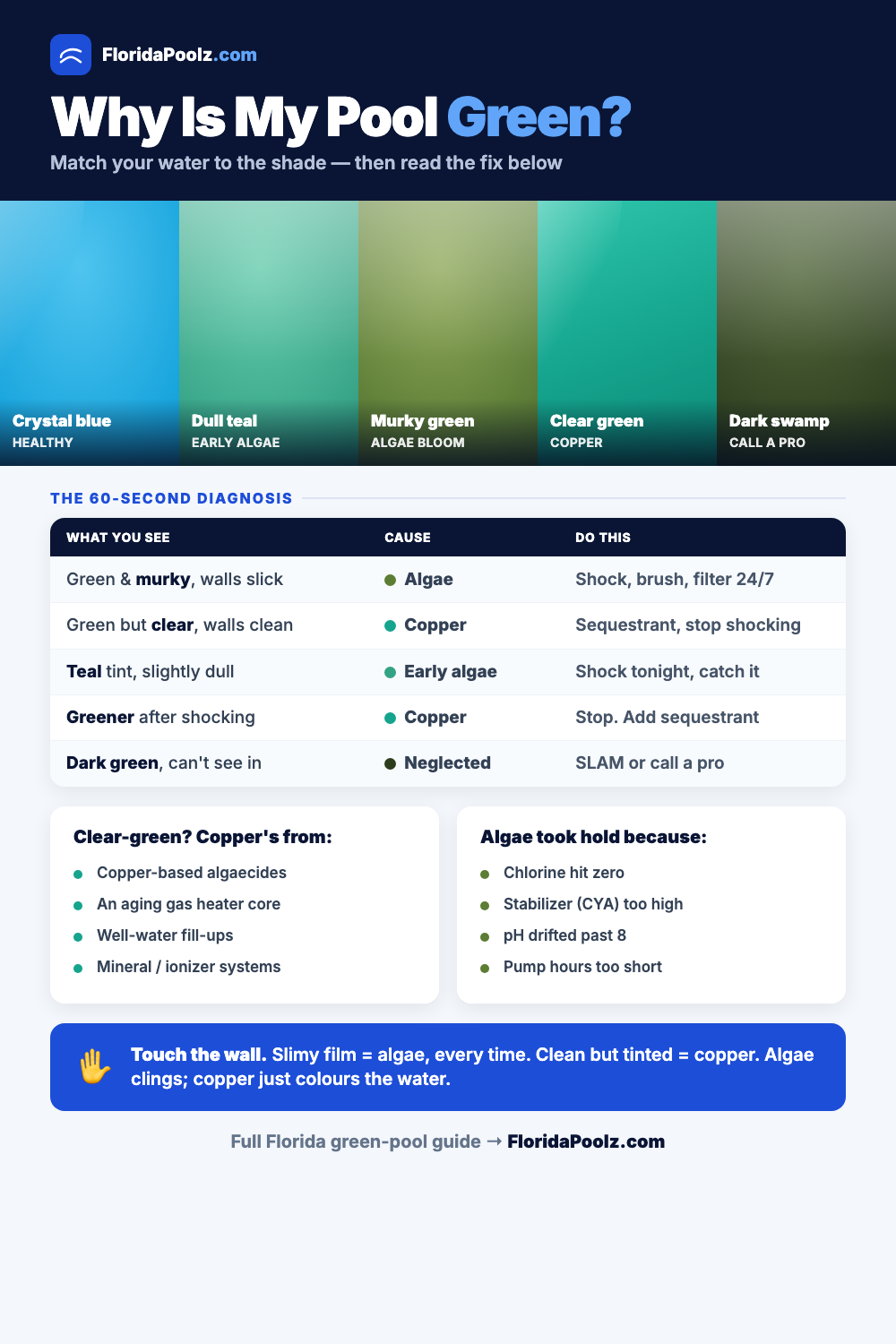
| What you see | The cause | What fixes it |
|---|---|---|
| Green and murky — bottom hazy or invisible, maybe slick walls | Algae bloom | Chlorine, brushing, filtering — the full kill process |
| Green like green glass — tinted but you can count the main drain screws | Dissolved copper | Sequestrant; find the copper source |
| Teal or green-tinged blue, slightly dull | Early algae, a day or two old | Catch it now: shock tonight, brush, filter |
| Green immediately after shocking | Copper oxidizing — the shock revealed it | Sequestrant, not more shock |
| Green hair or green fingernails after swimming | Copper again — classic tell | Same: treat the water, find the source |
One more look worth taking: touch the wall. Slimy film means algae regardless of how clear the water looks. Algae is alive and it clings; copper just tints.
Algae spores land in every Florida pool every day — carried by wind, rain, and everything the summer sky throws at your cage. Chlorine kills them on arrival. The moment free chlorine slips near zero, they grow, and in 88°F water they grow fast: a pool that tested fine Friday turns pea-soup by Monday. Every June, the state’s pool forums fill with the same photo and the same subject line.
What let it happen is nearly always one of these:
The diagnosis is easy to confirm: free chlorine tests at or near zero, walls feel slick, and the green deepens every warm day you wait. Don’t wait — algae roughly doubles daily in summer water, and the difference between a light-green pool and a black-green swamp is about three days. The fix is a sustained chlorine assault, not a single bag of shock; here’s the step-by-step green-to-clean process.
This is the one that breaks people, and it’s barely covered outside pool-tech circles. The water is green but transparent — bottom visible, walls clean, chlorine testing fine. Owners shock it anyway. It gets greener. The reason: dissolved copper oxidizes when chlorine spikes, and oxidized copper is what’s tinting the water. Every shock makes more of it.
Stop shocking. Add a metal sequestrant (look for HEDP or phosphonic acid on the label), run the pump 24 hours, and the tint fades as the copper gets locked back into solution. Sequestrant doesn’t remove copper — it handcuffs it, and it wears off — so a monthly maintenance dose is part of life for well-water pools.
Then close the source: retire the copper algaecide, test fill water before topping off from a well, and get pH off the floor — acidic water plus a copper heater core is the expensive version of this problem. Green hair after swimming is your early warning; it shows up before the water visibly tints.
The pool was blue-ish, you shocked it, and twenty minutes later it’s green. Nothing bloomed that fast — the chlorine oxidized dissolved copper you didn’t know you had. This exact sequence is how most owners find out they have a metal problem, and it usually traces to the well top-off or the algaecide habit within one conversation.
Treat it as copper (sequestrant, source-hunt) — and keep in mind the two problems coexist: a pool can bloom algae and carry copper. Kill the algae first, then chase the tint that’s left.
Salt pools grow the same algae for the same reason — the chlorine stopped. The difference is why it stopped, and in Florida it’s usually the cell:
A green salt pool gets the same treatment as any algae pool — manual liquid-chlorine shock, brush, filter. The cell can’t shock its way out; boost mode is for maintenance, not recovery. Once it’s clear, inspect and clean the cell, and test salt with strips rather than trusting the panel.
A Florida thunderstorm hands your pool three problems at once: rain dilutes the chlorine, runoff carries in fertilizer nitrogen from the lawn (algae food, straight up), and wind delivers organic debris through every screen panel. A pool that rode out a stormy week untested is a pool halfway to a bloom.
The post-storm routine that prevents the whole thing: skim and empty baskets, test that evening, restore chlorine immediately, and run the pump overnight. Ten minutes. The alternative is this article’s first section. A pool that clouds up after every rain has a filtration or chemistry margin problem — the storm is just the stress test it keeps failing; our cloudy water guide covers finding that weak link.
Every green pool traces back to one sentence: the chlorine stopped doing its job and nobody caught it for a few days. The prevention is the catching:
A pool that’s turned green on you twice this season is telling you the routine itself is broken — run time, equipment, or chemistry that needs a professional eye. A weekly service visit costs less than the chemicals for one more green-to-clean recovery; licensed Florida pool pros are one search away in the Pools Premium directory. For everything else, our pool care guides cover the routine end to end.
Two usual suspects. Clear-green water with strong chlorine is dissolved copper, not algae — sequestrant fixes it. Cloudy-green with strong chlorine usually means stabilizer (cyanuric acid) is so high the chlorine reads fine on a strip but works at a fraction of its strength. Test CYA; over roughly 100 ppm, a partial drain-and-refill is the honest fix.
In 85–90°F summer water, an algae bloom moves that fast — chlorine hit zero a day or two earlier and the bloom reached visible density overnight. If the overnight green is clear, it’s copper reacting to a chlorine or pH change, not growth.
A cloudy-green pool, no — sanitizer has failed, algae-slick surfaces cause falls, and murky water hides swimmers from view. Clear-green copper water with normal chlorine is safe in the health sense, though it may green light-colored hair. When in doubt, keep it closed — especially with kids.
Chlorine oxidizes dissolved copper, and oxidized copper tints water green — the shock revealed a metal problem rather than causing one. Confirm with a copper test (pool stores test it free), treat with sequestrant, and find where the copper’s coming from: algaecide, heater core, or well water.
No. Algae doesn’t run out of food in a Florida pool — every storm delivers more. An untreated bloom thickens from green to black-green, stains plaster, clogs the filter, and each waiting day makes recovery longer. Same-week treatment is dramatically cheaper than next-month treatment.

We build Florida's pool contractor directory from county permit records, DBPR license data, and verified Google reviews — and write these guides from the same data, with input from the licensed builders and service pros listed on the site.
Straight-talking, Florida-specific help — written from permit data and local pros.
How to lower pH in a pool with muriatic acid: dose amounts by pool size, safe handling steps,…
Read more →
Cyanuric acid protects chlorine from sun - until it climbs so high the chlorine stops working. The Florida…
Read more →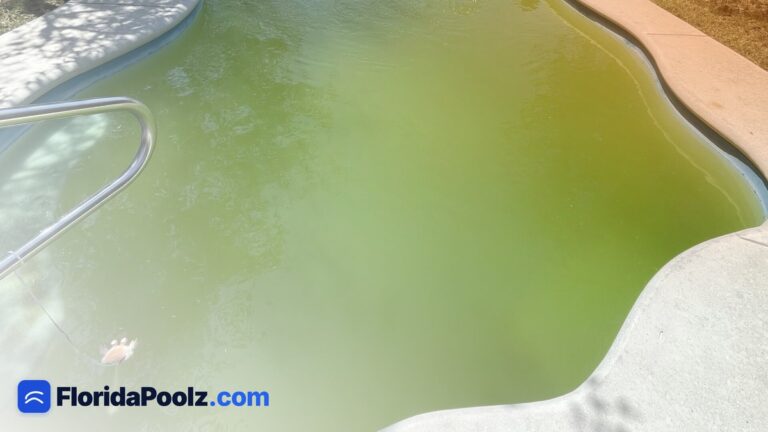
Mustard algae looks like dirt, brushes off in a yellow cloud, and resettles by morning. The kill protocol,…
Read more →