How to Lower pH in a Pool (Without Wrecking Your Alkalinity)
How to lower pH in a pool with muriatic acid: dose amounts by pool size, safe handling steps,…
Read more →Here’s how to get rid of algae in a pool, compressed to one line: raise chlorine to kill level and hold it there, brush everything, filter around the clock, then vacuum out the dead bloom. That’s the whole war. Everything below is making sure each step actually works — and that you’re not back here in three weeks, which is where most one-bag-of-shock treatments end.
Budget a weekend for a green pool, longer for a dark one. In a Florida summer the clock matters: a bloom roughly doubles daily in 88°F water, so today’s light-green is Friday’s swamp.
Three lookalikes get treated as algae and waste people’s weekends:
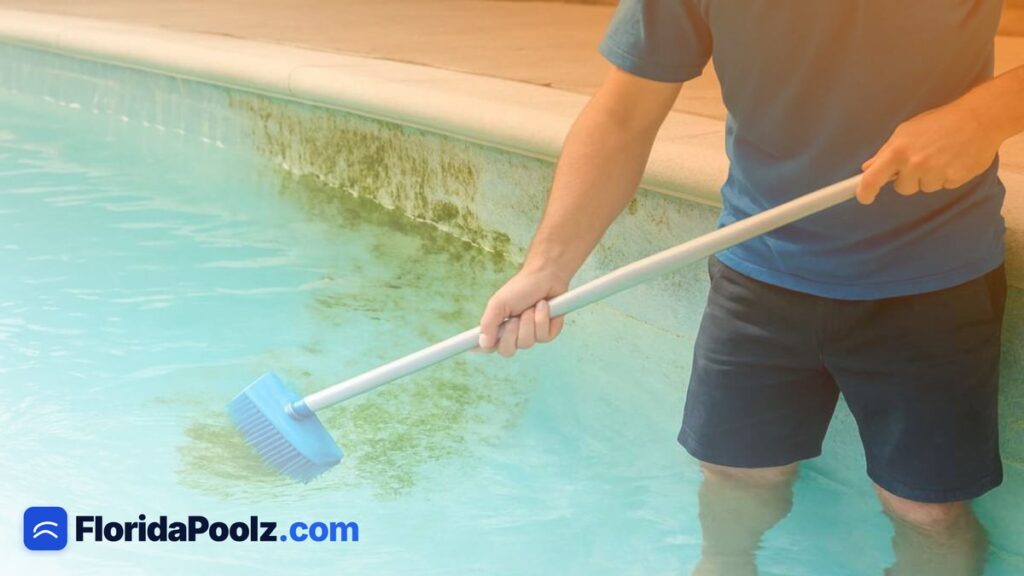
Real green algae: the water is murky, the walls feel slick, and it deepens by the day. Free chlorine tests at or near zero. That’s your target confirmed.
Two cousins need harder treatment than this guide’s process: mustard algae (dusty yellow film on shady walls that brushes off in a cloud and resettles) and black algae (raised dark spots with roots in the plaster that survive brushing). The kill sequence below still applies, but each has extra steps — dedicated guides are coming to the pool care section.
Cost check: a full DIY green-to-clean runs the price of chlorine and acid — call it modest double digits. Hiring it out is a legitimate choice at the black-green stage, where the labor gets real.
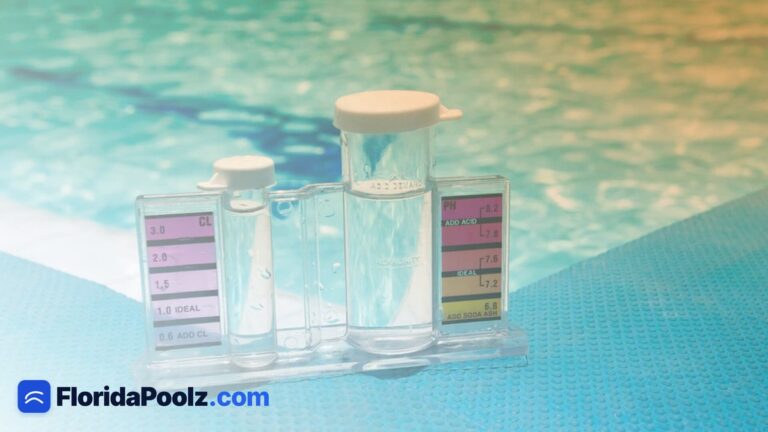
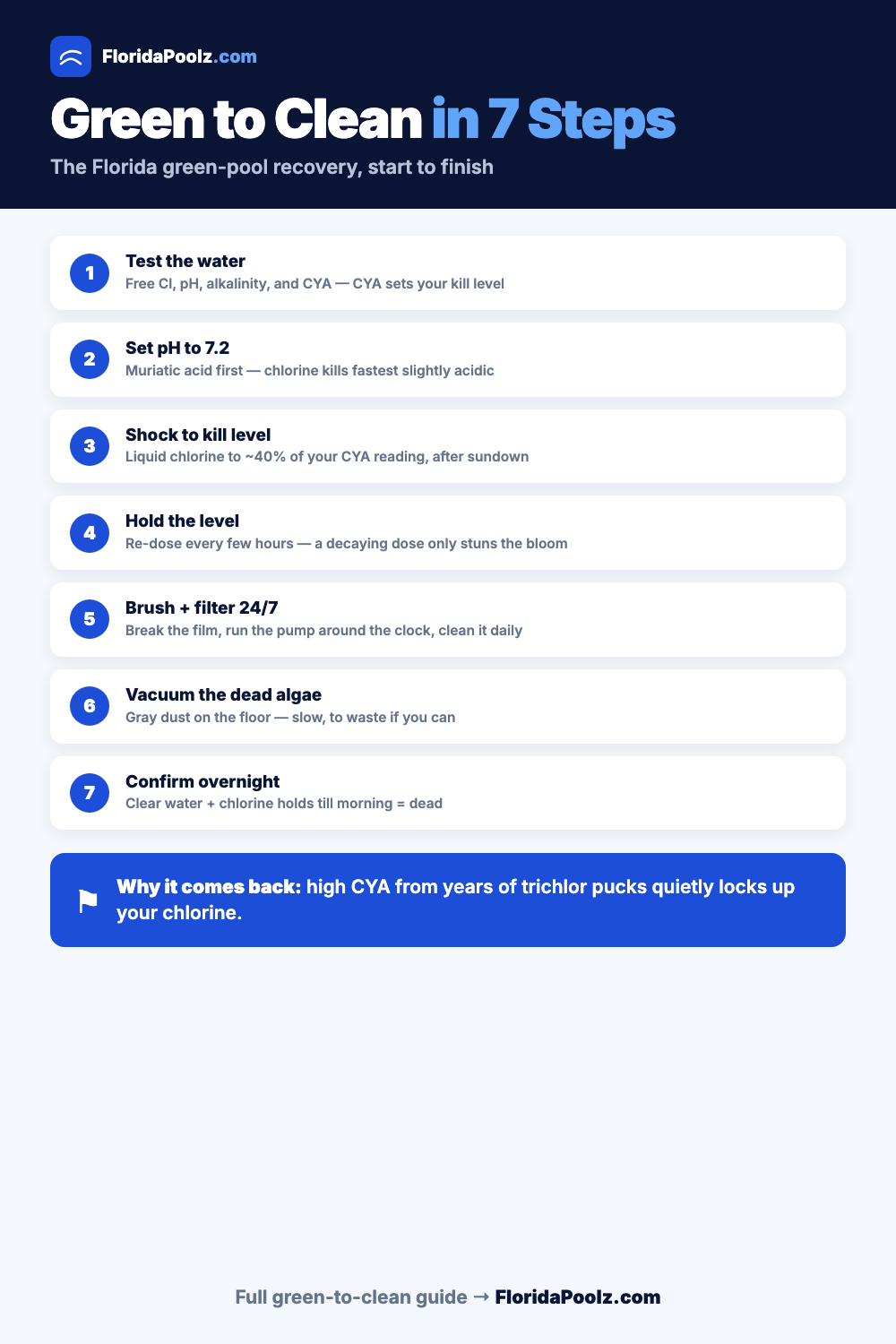
Free chlorine, pH, alkalinity, and cyanuric acid (CYA). That last one decides your whole battle plan: CYA sets how much chlorine it takes to reach kill level. The community-standard SLAM method (popularized by the Trouble Free Pool forum) targets free chlorine at roughly 40% of your CYA reading for algae-killing — CYA of 50 means holding around 20 ppm of chlorine, not the 3 ppm your strip calls “high.”
Years of trichlor pucks push Florida pools to CYA 100-plus, and at that level the math turns ugly: kill-level chlorine gets expensive and slow. CYA over ~100 ppm is the point where a partial drain-and-refill beats brute force — with a Florida caveat: high water tables can lift a fully drained shell out of the ground, so drain conservatively (a third to a half) and never in the rainy season without knowing your lot. When in doubt on a drain, that’s a pro call.
Chlorine kills fastest in slightly acidic water. Dose muriatic acid to bring pH to about 7.2, run the pump 30–60 minutes, retest. Do this before the chlorine goes in — kill-level chlorine makes pH readings unreliable afterward, so this is your one clean shot.
Dose liquid chlorine to your target (the 40%-of-CYA number), pouring slowly around the perimeter with the pump running. After dark matters: Florida UV strips unstabilized chlorine fast, and you want every ppm working the night shift on algae instead.
The part everyone skips, and the reason blooms come back: hold the level. Kill-level chlorine gets consumed by everything it kills — test every few hours the first day and re-dose back to target each time. One heroic dose that decays overnight stuns the bloom; a held level for two, three, four days exterminates it.
Algae protects itself with a surface film that chlorine struggles to punch through. Brushing tears the film and throws the cells into open water where the chlorine is waiting. Every surface, every day of the fight: walls, floor, steps, swim-outs, behind ladders, the waterline. Corners and shaded spots — under a Florida cage, that’s often the whole shallow end — get extra passes; shade is where blooms hold out.
The pump runs 24/7 until the water is clear. Not on its summer schedule — continuously. Watch the filter pressure: dead algae will choke it fast, so backwash or rinse the cartridge every time pressure climbs 8–10 psi over clean baseline. Expect to clean it daily during the heavy phase; a choked filter quietly stalls the whole recovery.
Killed algae turns the water gray-white, then settles as fine dust on the floor — that gray dust is the corpse of your bloom, and it’s too fine for casual skimming. Vacuum slowly, by hand, and send it to waste if your valve has the setting (it bypasses the filter entirely). Rush the pass and the dust billows up to resettle an hour later. Robotic cleaners with fine-mesh bags manage it; suction-side cleaners mostly stir it.
Cartridge-filter pools without a waste line: vacuum in short sessions and rinse the cartridge between rounds. Slower, works fine.
The bloom is dead when all three hold: the water is clear, chlorine holds overnight (test at dusk and dawn — losing 1 ppm or less with no sun means nothing’s alive and eating it), and the walls squeak instead of slime. Then stop dosing, let chlorine drift down to the normal 3–5 ppm, correct pH back to 7.4–7.6, and swim.
Skipping the overnight test is how half-dead blooms get declared victories. Two minutes of testing versus a rematch in ten days — take the test.
A pool that regrows algae within weeks didn’t get reinfected by bad luck. One of these is still true:
National guides talk about “opening” the pool and algae season ending in fall. Florida pools don’t close, water stays warm enough to grow algae twelve months a year, and summer adds a daily storm cycle that feeds and reseeds blooms. What that means in practice: the prevention routine runs twelve months — lighter in January, never off. The pools that never turn green here share one habit: chlorine never touches zero, and someone tests often enough to know.
Prevention, compressed: free chlorine 3–5 ppm always, pH 7.4–7.6, test twice weekly in summer, brush weekly, full pump turnover daily, and skim-test-dose the evening after every storm. That routine costs minutes; a bloom costs a weekend.
DIY wins on a green pool caught early. The math changes when the pool is black-green with zero visibility (days of chemical warfare plus a filter-management grind), when CYA demands a drain you’re not equipped to judge against the water table, or when the bloom traces to failed equipment — a dead cell or an undersized filter that guarantees a repeat. Florida pool services run flat-rate green-to-clean packages for exactly this situation, and a licensed pro pressure-tests the system during the same visit. Find one in your county through the Pools Premium directory — and either way, keep the water from clouding up again with our clear-water maintenance guide.
Enough to reach roughly 40% of your CYA reading in free chlorine, held for days — not one fixed number of bags. A CYA-50 pool needs about 20 ppm sustained; light green might take 4–6 gallons of liquid chlorine over the fight, dark green double that. The dose that fails is any dose applied once and allowed to decay.
Light green caught early: 2–3 days to swimmable. Full pea-soup: 4–7 days including the cleanup vacuuming. Black-green neglect: a week-plus, and a fair candidate for a green-to-clean service. The held-chlorine phase is most of the timeline; the clearer the water when you start, the shorter it runs.
Skip it. Algae itself won’t hurt you, but a bloom means sanitizer failure — the water isn’t protected against the microbes that do cause trouble, slick surfaces cause falls, and murky water hides swimmers from view. During kill-level chlorination the pool is closed regardless; wait for clear water and chlorine back under 5 ppm.
Neither touches algae. Baking soda raises alkalinity; vinegar is a futile acid at pool scale. The home-remedy route costs days of bloom growth — in summer heat, that’s the difference between a green pool and a black one. Chlorine, brushing, filtration: that’s the kill.
Not to kill a bloom — chlorine does that better and cheaper. A quality polyquat (Polyquat 60) algaecide has a place as insurance in specific spots: before a vacation week, or in a pool with a known circulation dead spot. Skip copper-based algaecides entirely; the copper accumulates and eventually hands you a clear-green metal-tinted pool that shocking makes worse.
That cloud is the dead bloom itself — microscopic corpses waiting for the filter. Keep the pump on 24/7, keep rinsing the filter as pressure climbs, vacuum the settling dust slowly, and give it 24–72 hours. Stalled progress usually means a choked filter nobody’s cleaned since the kill.

We build Florida's pool contractor directory from county permit records, DBPR license data, and verified Google reviews — and write these guides from the same data, with input from the licensed builders and service pros listed on the site.
Straight-talking, Florida-specific help — written from permit data and local pros.
How to lower pH in a pool with muriatic acid: dose amounts by pool size, safe handling steps,…
Read more →
Cyanuric acid protects chlorine from sun - until it climbs so high the chlorine stops working. The Florida…
Read more →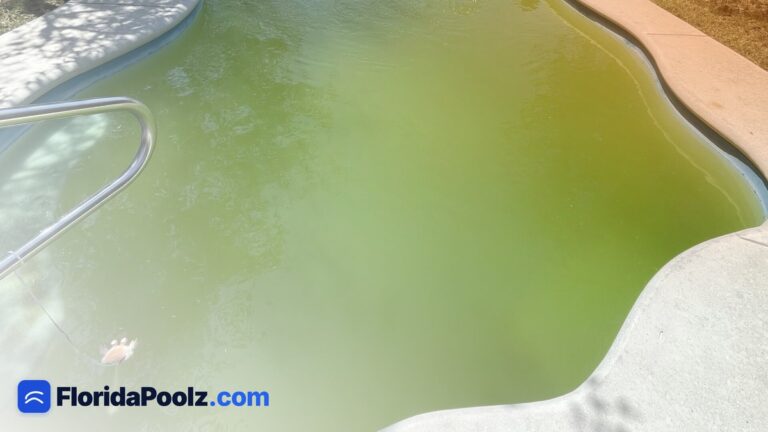
Mustard algae looks like dirt, brushes off in a yellow cloud, and resettles by morning. The kill protocol,…
Read more →