How to Lower pH in a Pool (Without Wrecking Your Alkalinity)
How to lower pH in a pool with muriatic acid: dose amounts by pool size, safe handling steps,…
Read more →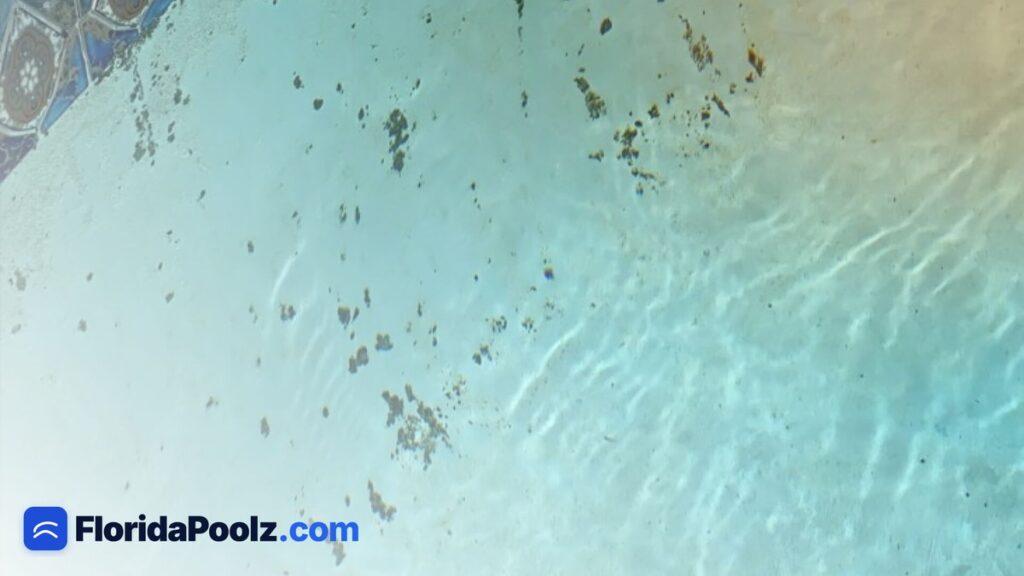
Black algae in a pool is a different opponent than the green stuff. It’s not a floating bloom — it’s a rooted organism drilled into your plaster, wearing a waxy armor coat that laughs at the shock dose that would nuke green algae overnight. Killing it means breaking the armor by hand, spot by spot, over weeks. Anyone promising a one-weekend fix is selling you a bottle.
The honest timeline: two to four weeks of repeated treatment for a real infestation, then a permanent change to your brushing habits. Here’s the whole fight.
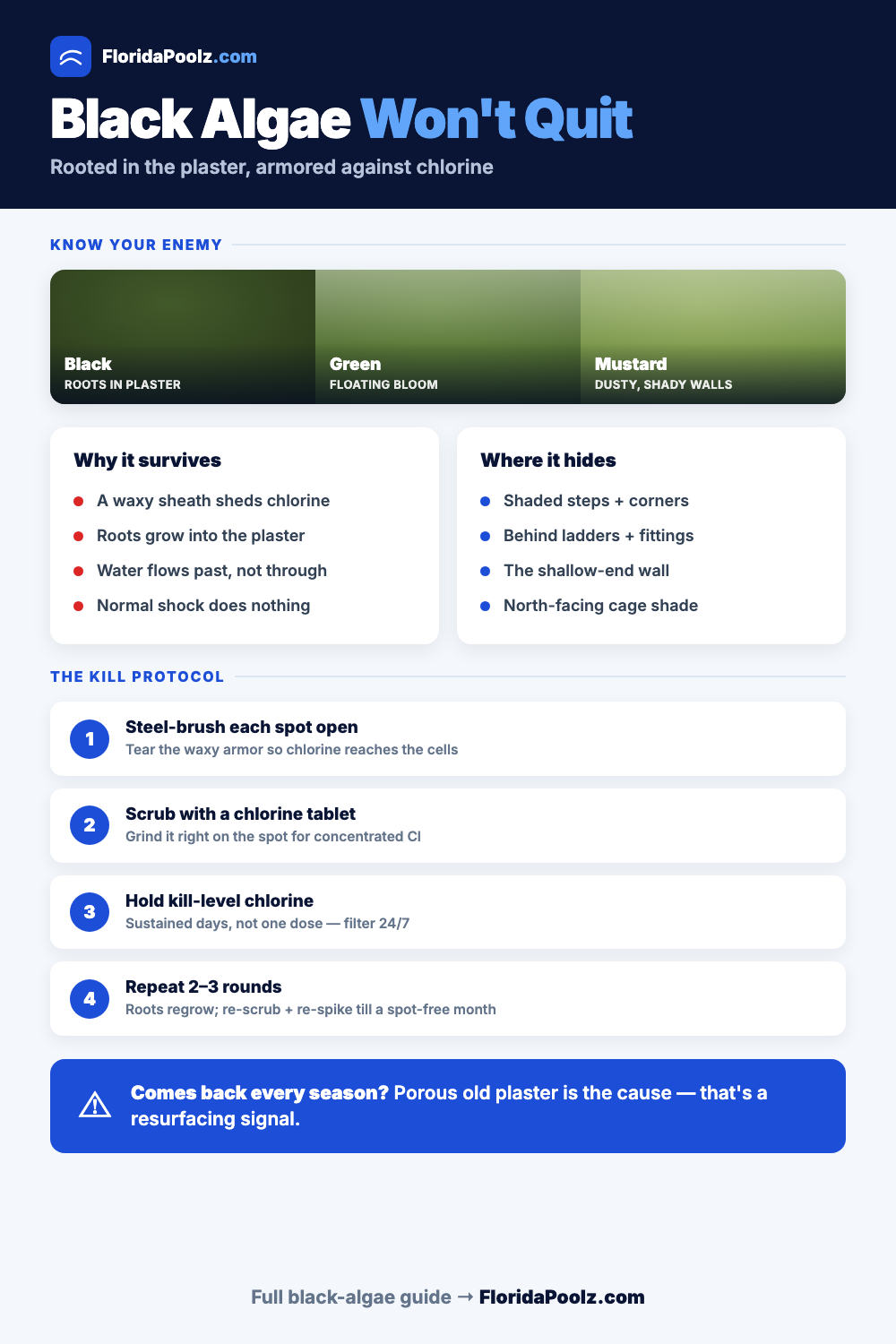
The name lies twice. It isn’t black — it’s a blue-green so dark it reads black. And it isn’t quite algae — it’s cyanobacteria, an older, tougher lineage that builds two defenses regular algae never developed:
You’ll see it as raised dark spots the size of a pencil eraser to a quarter, usually starting in shaded, low-circulation areas — steps, corners, the shallow-end wall under the cage screen’s densest shade. Wipe a spot with a finger: black algae feels bumpy and stays put. A smooth dark smudge that wipes away is more likely a stain or dead leaf tannin — and green algae, by contrast, slimes and clouds the whole pool. Not sure which you’re fighting? Start with the green-pool diagnosis guide.
Black algae is overwhelmingly a plaster and gunite problem — the porous surface gives the roots somewhere to grip. Fiberglass and vinyl pools get it rarely, and mildly, on their roughest spots. Most Florida pools are gunite. Add year-round warm water, brutal summer sun that burns off chlorine by 3 p.m., and screened enclosures throwing permanent shade bands on the same wall sections, and you have the black-algae belt.
The spores arrive on wind, storm debris, and — the classic vector — swimsuits and pool toys that visited the ocean or a lake. A suit that swam a Florida spring last weekend is a colonization event waiting for your first low-chlorine day.
Shock works on green algae by flooding open water with oxidizer — the cells float exposed, the chlorine tears them apart. Black algae presents almost no exposed surface. The sheath sheds oxidizer, the roots sit in plaster where dissolved chlorine barely reaches, and water flows past a colony, not through it. You can hold a pool at triple shock for a week and the spots survive.
The protocol that works reverses the order: physical assault first, chemistry second. Break the armor, then let chlorine at the exposed tissue.
A stainless-steel algae brush (plaster and gunite only — steel destroys vinyl and fiberglass) is the whole game. Scrub every spot until the raised head is torn open and the spot looks lighter. You’re not removing it yet; you’re breaching the sheath. For spots on steps and shallow corners, a putty knife or a chlorine tablet held in a holder and rubbed directly on the spot works even better — the tablet grinds and delivers concentrated chlorine in one motion. Wear gloves.
With the colonies opened, run the same sustained-chlorine siege that kills any algae: liquid chlorine to roughly 40% of your CYA reading, re-dosed as it burns down, held for days. The full method — dosing math, pH prep, the overnight test — is in the green algae master guide, and it applies here unchanged. One Florida caveat before you start: if years of trichlor pucks have your stabilizer over 100 ppm, chlorine can’t do its share of this fight — check the cyanuric acid guide first.
Every day of the siege: full-pool brushing, plus a targeted steel-brush pass on every known spot. Colonies that still look raised get the tablet treatment again. The filter runs 24/7 through all of this; clean it whenever pressure climbs 8–10 psi over baseline.
Ten days later, a few spots will re-darken — that’s roots regrowing, not new infection. Re-scrub, re-spike the chlorine over a weekend, repeat. Two or three cycles is normal. The infestation is beaten when a month passes with no returning spots.
Run swimsuits through a hot wash, soak toys and floats in dilute bleach, do the same for brush heads and vacuum gear. Reinfection from gear is how a won war restarts a month later — the same trap that makes mustard algae so persistent.
A pool that grows black algae across large areas year after year, past good chemistry and honest brushing, is usually telling you about its surface, not its water. Old plaster — 12, 15, 20 years in — gets rough and porous, and every pore is a root anchor. At that point each black-algae campaign buys you a season, and resurfacing is the actual cure: fresh plaster or pebble takes away the foothold entirely. That’s a remodel conversation with a licensed contractor, and worth having before the next replaster season books out — Florida resurfacing pros are in the directory.
The colonies themselves mostly aren’t the issue — the water conditions that let them grow are. Some cyanobacteria produce toxins, and a pool weak enough in chlorine to grow black algae isn’t sanitizing anything else either. Treat the pool as closed during the kill protocol’s high-chlorine phases, and don’t let kids pick at the spots.
Not on its own. Copper-based products marketed for black algae have some effect on opened colonies but bring a real cost: copper accumulates and eventually tints your water — the clear-green pool problem. Brushing plus sustained chlorine outperforms any bottle; if you want backup, a quality polyquat is the safer choice.
Tempting, and in Florida often dangerous — a drained shell in high water table season can lift out of the ground. Draining also doesn’t kill the roots in the plaster; colonies re-emerge on refill. If the surface is bad enough to justify a drain, it’s usually bad enough to justify resurfacing, and both are licensed-contractor territory.
Roots. The visible head dies, the anchor survives in the plaster pore, and the colony regrows from the root like a dandelion. Spots that return more than twice after proper scrub-and-siege treatment mark plaster that’s porous enough to protect the root fully — those spots are resurfacing evidence.
Two to four weeks for an established infestation: an aggressive opening weekend, then daily brushing with one or two follow-up chlorine spikes as stragglers reappear. A pool with three or four young spots caught early comes clean in a week. Declare victory only after a spot-free month.

We build Florida's pool contractor directory from county permit records, DBPR license data, and verified Google reviews — and write these guides from the same data, with input from the licensed builders and service pros listed on the site.
Straight-talking, Florida-specific help — written from permit data and local pros.
How to lower pH in a pool with muriatic acid: dose amounts by pool size, safe handling steps,…
Read more →
Cyanuric acid protects chlorine from sun - until it climbs so high the chlorine stops working. The Florida…
Read more →
Mustard algae looks like dirt, brushes off in a yellow cloud, and resettles by morning. The kill protocol,…
Read more →