How to Lower pH in a Pool (Without Wrecking Your Alkalinity)
How to lower pH in a pool with muriatic acid: dose amounts by pool size, safe handling steps,…
Read more →
Salt water vs chlorine pool comes down to one surprise most people never hear: a salt pool is a chlorine pool. The salt system makes its own chlorine on-site instead of you pouring it in. So the real decision isn’t “salt or chlorine” — it’s “generate chlorine automatically at a higher upfront cost, or add it manually for less money.” In Florida, with a year-round swim season, that trade lands differently than it does up north.
Here’s the whole comparison, with real Florida factors — cage corrosion, cell lifespan in a 12-month season, and what builders around the state actually install now.
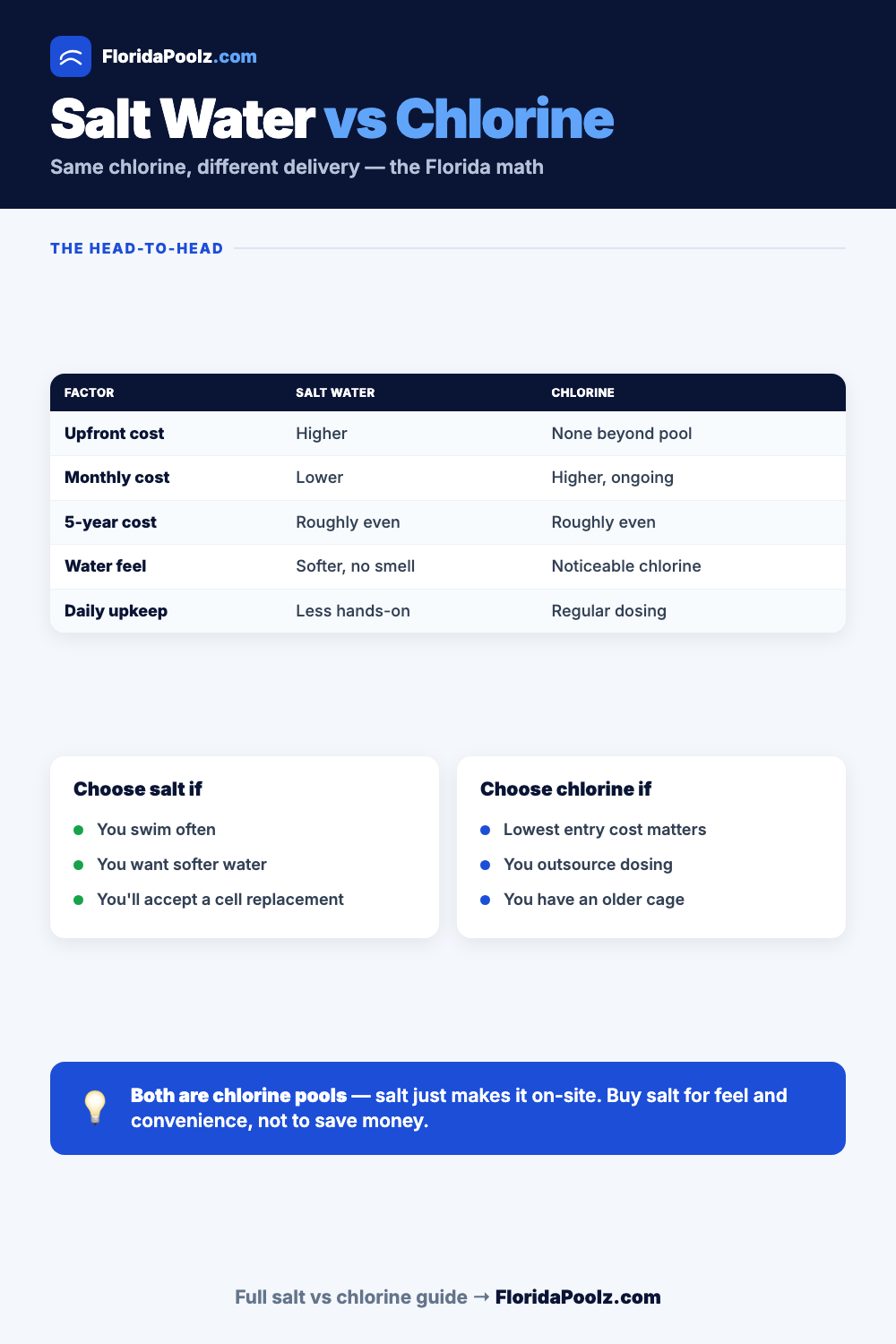
| Factor | Salt water | Traditional chlorine |
|---|---|---|
| Upfront cost | Higher (system + install) | None beyond the pool |
| Monthly cost | Lower (just salt + acid) | Higher (liquid/tabs ongoing) |
| 5-year cost | Roughly even once a cell replacement hits | Roughly even |
| Feel of the water | Softer, gentler on eyes/skin | More noticeable “chlorine” feel |
| Maintenance time | Less hands-on day to day | More frequent dosing |
| Florida catch | Cell wears faster in year-round use; salt + metal questions | Constant chlorine errands in summer |
Neither is “better.” Salt buys convenience and water feel for a higher entry price; chlorine keeps it cheap and simple to start. The tiebreakers in Florida are cost-over-time and corrosion — both below.
A salt water pool runs a chlorine generator (a “salt cell”) on the equipment pad. You keep the water lightly salted — around 3,000–3,500 ppm, roughly a tenth as salty as the ocean — and the cell uses electrolysis to convert that salt into chlorine as water flows through. The chlorine sanitizes, then reverts to salt, and the cycle repeats. You’re still swimming in chlorinated water; you just aren’t buying and pouring it.
A traditional chlorine pool gets its chlorine added directly — liquid chlorine, tablets in a feeder, or granular shock. You dose it yourself (or a service does) on a schedule. Simple, cheap to start, and completely manual.
The “chemical-free saltwater” marketing is a myth worth killing: both pools sanitize with chlorine. The difference is the delivery method, not the chemistry.
This is where the decision usually gets made, and where the honest numbers matter. Treat these as general Florida ranges — your pool size, usage, and local prices move them, and it’s exactly the kind of figure worth confirming with a couple of local quotes.
Over five years the two tend to converge: the salt pool’s low monthly cost gets partially eaten by a cell replacement or two, while the chlorine pool’s steady tab/liquid spend adds up. Salt rarely “saves money” the way owners expect — its real payoff is convenience and water feel, not the budget.
National cell-lifespan estimates (roughly 3–7 years) assume pools that close for winter. Florida pools don’t close — the cell generates chlorine twelve months a year, so it logs its rated hours faster. Plan for cell replacement toward the shorter end of the national range here. It’s a real line item, not a maybe.
This is the most-argued point in Florida pool circles, and the honest answer is “it depends, but respect it.” Salt water is mildly corrosive over time. It can accelerate wear on:
None of this is a dealbreaker, and good equipment plus regular rinsing manages it. But if you have an older aluminum cage or travertine deck you love, factor it in — it’s a fair question to put to a builder before converting.
Salt cells naturally push pH upward as they run, so salt pools in Florida — already prone to high-pH drift from aeration and hard fill water — need regular acid to stay balanced. It’s a small, predictable chore, not a problem, but it’s part of “low maintenance,” not “no maintenance.”
Set cost aside and this is salt’s strongest card. The lower, steadier chlorine level and the trace salinity make the water feel softer — easier on eyes, gentler on skin, no strong chlorine smell. Families with kids who swim daily (a very Florida situation) notice it most. It’s not a health difference; it’s a comfort difference, and it’s genuine.
Salt wins day-to-day. The generator holds a steady chlorine level automatically, so a salt pool needs less frequent hands-on dosing — you’re mostly checking salt level, pH, and stabilizer, and cleaning the cell of scale a few times a year. A chlorine pool needs someone adding chlorine on a real schedule, especially through a Florida summer when stabilizer and sun dictate how fast it disappears. Either way, the water chemistry fundamentals are identical — salt just automates the chlorine half.
Straightforward and popular in Florida. A tech installs the cell and control board on your existing equipment pad, adds salt, and dials it in — no draining, most of your existing equipment stays. The main cost is the system and install. Before converting, get the water table and your cage’s condition looked at, and have someone confirm your heater and fixtures are salt-friendly. It’s a half-day job for a licensed pro — find one in the directory.
Whichever way you lean, the install or conversion is licensed work worth getting two quotes on — licensed Florida pool pros are in the directory, and the rest of the decisions live in our pool care guides.
Cheaper month to month, not cheaper across five years. You save on chlorine but pay upfront for the system and eventually for cell replacements — which come faster in Florida’s year-round season. Over five years the two roughly even out. Buy salt for convenience and water feel, not to save money.
Salt water is mildly corrosive and can accelerate wear on cage fasteners and lower framing over years, especially where splash-out lands. Modern cages and regular rinsing manage it well, but with an older aluminum cage it’s a real consideration — ask a builder before converting.
Toward the shorter end of the national 3–7 year range, because Florida pools run year-round and the cell logs its hours faster. Cleaning scale off the cell a few times a year extends its life. Budget for replacement as a known cost, not a surprise.
Yes — the steadier, lower chlorine level and trace salinity make the water feel softer, with no strong chlorine smell. It’s a comfort difference, not a health one, and it’s the main reason families choose salt.
Easily. A tech adds a salt cell and control board to your existing pad and salts the water — no draining, most equipment stays. Confirm your heater and metal fixtures are salt-compatible first, and mind an older cage. It’s typically a half-day job for a licensed pro.

We build Florida's pool contractor directory from county permit records, DBPR license data, and verified Google reviews — and write these guides from the same data, with input from the licensed builders and service pros listed on the site.
Straight-talking, Florida-specific help — written from permit data and local pros.
How to lower pH in a pool with muriatic acid: dose amounts by pool size, safe handling steps,…
Read more →
Cyanuric acid protects chlorine from sun - until it climbs so high the chlorine stops working. The Florida…
Read more →
Mustard algae looks like dirt, brushes off in a yellow cloud, and resettles by morning. The kill protocol,…
Read more →